Sometimes when you read an article about tuning proportional-integral-derivative (PID) loops, you’re treated to all the 2nd order differential equations they contain. These can be intimidating, especially if your college calculus classes are many years in the rearview mirror. If you find yourself in this situation, there’s a great Chemical Engineering Progress article, Implement an [...]
Audio clip: Adobe Flash Player (version 9 or above) is required to play this audio clip. Download the latest version here. You also need to have JavaScript enabled in your browser.
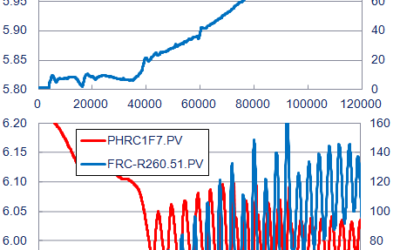
I received an interesting story from Emerson’s James Beall about a process manufacturer with a process filled with many fermentors. They were being converted over from Provox control systems to DeltaV systems. pH control was a key part of the plant’s fermentation process. The first two fermentors were converted over but were now cycling. The [...]
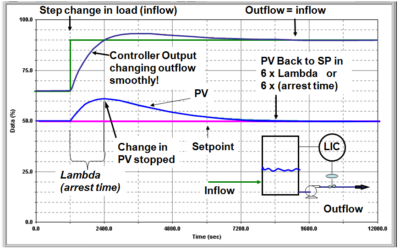
Earlier this week, I highlighted a presentation by Emerson’s James Beall, Fundamentals of Modern Loop Tuning. I shared his approach for tuning self-regulating loops and the sequence to tune interacting loops. Today, I’ll share some guidance from the portion of the presentation on integrating processes. An example of an integrating process is a tank level. [...]
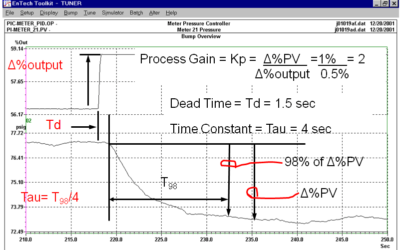
I’ve highlighted a few Emerson presentations for this week’s ChemInnovations conference in New Orleans. Emerson’s James Beall, a 30-year veteran in process control and chairman of the ISA 75.25 committee on control valve performance testing, shared his ChemInnovations presentation with me as well. The subject is a look at the fundamentals of modern loop tuning. [...]
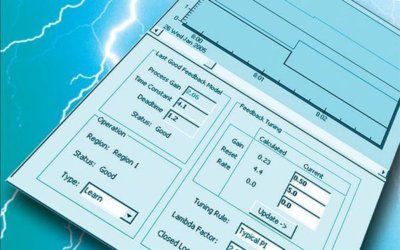
Last week, I highlighted a narrated presentation on PID control advances by Emerson’s Terry Blevins. Also at this IFAC Conference on Advances in Process Control PID’12, Terry presented Intelligent PID Product Design. A paper to complement this presentation was authored by the Emerson team including Willy Wojsznis, John Caldwell, Peter Wojsznis, Mark Nixon, and Terry. [...]